Most guides to removing cigarette smell from a home give you the same list: open windows, spray air freshener, light a candle. These methods work for maybe 20 minutes. The reason they don't last is that cigarette smoke odour is not primarily an air problem — it's a surface problem. The 7,000+ compounds in tobacco smoke include highly reactive gases that chemically bond to fabric fibres, penetrate plaster, lodge in carpet pile, and embed in upholstery foam. This residue — called thirdhand smoke — slowly re-releases these compounds into the air for weeks to months after the smoking event. Air freshener masks the smell for minutes. Vinegar, baking soda, and serious ventilation actually address it. And one approach stops it before it starts.
There are two fundamentally different approaches to smoke smell in the home: source control (capturing smoke before it reaches surfaces and air) and remediation (cleaning up smoke after it has already embedded). Every method from 2 to 8 on this list is remediation — they are all cleaning up after the smoke has already done its damage to your home's air and surfaces. Method 1 — using a personal smoke filter at the moment of exhalation — is the only approach that prevents the smell from occurring in the first place. For persistent smoke smell in an Indian home with a regular indoor smoker, Method 1 combined with ventilation (Method 2) is far more effective than any amount of surface cleaning alone.
When you smoke indoors, two types of smoke are produced: mainstream smoke (exhaled by the smoker) and sidestream smoke (rising from the burning cigarette tip). Both contain the same compounds, but in different ratios. These gaseous and particulate compounds — including nicotine, tar, acetaldehyde, acrolein, ammonia, and dozens of others — do not remain airborne for long. Within minutes they settle and bond to every surface in the room.
The resulting thirdhand smoke residue is not just unpleasant — research shows it continues to off-gas these compounds back into the room air for weeks to months. This is why a room that has been smoked in for years still smells even after the smoker has left and windows have been opened. The smell is in the walls, the carpet, the sofa foam, and the ceiling — not in the air.
This is also why air fresheners and candles produce zero lasting effect: they add a competing smell on top of ongoing off-gassing from contaminated surfaces, then dissipate — leaving the smoke smell behind, unchanged.
The 8 Methods — Ranked by Effectiveness
This is the only method that stops smoke smell from occurring rather than cleaning it up afterwards. A personal smoke filter — sometimes called a sploof — is a handheld device the smoker exhales into. The exhaled smoke passes through an activated carbon filtration medium that captures smoke compounds before they reach the room's air. Unlike an air purifier (which filters room air after smoke has already dispersed and settled on surfaces), a sploof works at the point of exhalation, where the smoke is most concentrated and most capturable.
For indoor smokers in India who cannot always smoke outside — due to monsoon seasons, shared building layouts, or family situations — this is the most practically effective odour management approach available. The Ventipure Sploof is designed specifically for this purpose, with a replaceable activated carbon cartridge system rated for 800+ uses.
Ventilation is the most effective free method for airborne smoke — but it must be done correctly. Opening one window does not create airflow; it creates a dead zone. For effective smoke clearance, you need cross-ventilation: windows on opposite sides of the room open simultaneously, with a fan positioned to exhaust outward in the lower portion of one window (smoke-laden air rises, so exhausting low forces it out while fresh air enters through the upper gap). A box fan moving 1,500–2,500 CFM can cycle a standard 12×12 ft room's entire air volume in under 3 minutes.
White vinegar works because of chemistry, not smell masking. Cigarette smoke residue is alkaline; white vinegar is acidic (acetic acid, pH ~2.5). The acid neutralises the alkaline smoke compounds on contact — not just covering them, but chemically breaking them down. The vinegar smell itself dissipates within 10–15 minutes as it dries, taking the neutralised smoke compounds with it. This is why vinegar works where air fresheners (which are purely masking agents) do not.
Baking soda (sodium bicarbonate) is alkaline and neutralises the acidic components of smoke residue through direct chemical reaction — different compounds from the alkaline ones that vinegar targets. Together they address a broader range of smoke compounds. More importantly, baking soda penetrates into carpet fibres and upholstery pile where sprays cannot reach — absorbing embedded odour molecules from deep in the material. Research notes that it may be impossible to completely remove all smoke traces from heavily contaminated carpets, but baking soda treatment significantly reduces the odour load.
Fabrics are the primary odour reservoir in any smoked-in room — curtains, cushion covers, bed linen, and clothing absorb smoke compounds preferentially because of their large surface area and porosity. Washing them is the most effective single intervention for these items. The key additions: a cup of white vinegar in the wash cycle (neutralises alkaline smoke residue that detergent alone doesn't fully remove); hot water where the fabric can tolerate it; and line-drying outdoors rather than tumble-drying (machine heat can bake in remaining odour compounds).
For rooms where smoking occurs regularly, an air purifier with activated carbon filtration is the most effective ongoing air management tool. HEPA filters alone capture particulate matter (smoke particles) but do not address the gaseous components (the smell-producing volatile organic compounds). Activated carbon — granular carbon with enormous surface area — physically adsorbs these gaseous compounds, removing them from the circulating air. The combination of HEPA (for particles) and activated carbon (for gases) is essential. Air purifiers labelled "HEPA type" should be avoided — they may not meet the standard.
Walls, ceilings, light fixtures, shelves, and furniture surfaces accumulate a visible yellowish-brown nicotine and tar film in rooms smoked in regularly. This film is a major odour source and also degrades surface finishes. Wiping down all hard surfaces is a necessary step in any serious smoke odour remediation — and it reveals how much residue has accumulated (the cloth turns yellow immediately).
Bowls of dry baking soda, activated charcoal powder (available at aquarium/pet shops in India), or fresh coffee grounds placed around the room provide ongoing passive absorption of airborne odour molecules between active cleaning sessions. These are not primary solutions — they cannot address embedded surface odour — but they reduce the background airborne odour load continuously and are cheap and practical for Indian homes.
The Ventipure Sploof — Source Control for the Indian Home
Method 1 stands apart from every other method on this list for a simple reason: it is the only one that prevents the smoke from reaching your home's surfaces and air in the first place. Every other method is remediation — you are cleaning up what has already happened. Source control is why it is listed first.
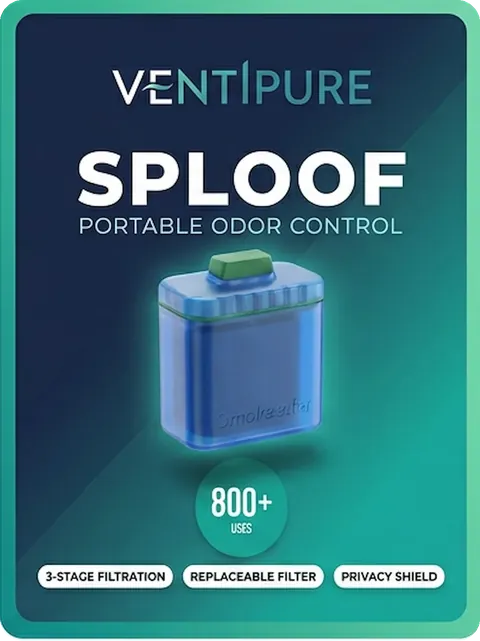
The Ventipure Sploof is a personal smoke exhalation filter designed for indoor smokers who want to significantly reduce the smoke odour their smoking produces in the home environment. It uses a replaceable activated carbon cartridge that captures the exhaled smoke compounds before they disperse into the room.
Who it is for: Indoor smokers in India who cannot always smoke outside — due to the monsoon, shared building layouts, family situations, or work-from-home environments — and who want to meaningfully reduce the smoke impact on their home without constant deep cleaning.
The cartridge is replaceable — the device is reusable. At 800+ uses per cartridge, a single cartridge lasts most smokers 4–6 weeks of daily use before replacement.
View Ventipure Sploof Replacement cartridgeSurface-Specific Guide — What Works on What
| Surface | Best Method | What to Avoid |
|---|---|---|
| Curtains & drapes | Machine wash hot with vinegar in rinse cycle. Line-dry outdoors. Vinegar spray between washes. | Tumble drying — heat bakes in remaining odour. Air freshener spray — masks only. |
| Carpets & rugs | Baking soda generously applied overnight, then thorough vacuuming. Repeat weekly. Professional steam cleaning for severe cases. | Wet shampooing repeatedly — can trap moisture and worsen odour. Note: deeply embedded carpet smell may not fully clear without professional extraction. |
| Upholstered sofas & chairs | Baking soda application (sprinkle, leave, vacuum). Vinegar spray on fabric surfaces. Cushion covers removed and machine washed if possible. | Soaking upholstery with water — can cause mildew. Steam cleaning alone — doesn't reach deep into foam. |
| Walls & ceilings | Wipe with vinegar-water or baking soda solution. For years of accumulation: odour-sealing primer before repainting. | Painting directly over heavy nicotine residue — smell bleeds through new paint within weeks. |
| Hard furniture & shelves | Wipe with vinegar-water solution. For wood: wood-specific cleaner to protect finish. | Harsh bleach solutions on wood — damages finish permanently. |
| Clothing & personal items | Machine wash with vinegar in rinse. Line-dry outdoors. Baking soda in a sealed bag overnight for items that cannot be washed. | Dry cleaning alone — solvents mask but may not fully remove smoke compounds from fibres. |
| Room air (ongoing) | Activated carbon + HEPA air purifier running continuously. Passive bowls of baking soda or activated charcoal. | Air fresheners — purely masking, no removal of compounds. |
In Indian apartment living, cigarette smoke crossing into neighbouring spaces is a common source of household conflict. The most effective containment approach: smoke in one room with the door closed and a towel or door seal at the base; keep windows in the smoking room open; use the Ventipure Sploof for exhaled smoke; and run an activated carbon air purifier in the smoking room to capture sidestream smoke before it builds up enough pressure to move under the door. This is not perfect containment, but it is significantly better than smoking anywhere in an open-plan space.
Frequently Asked Questions
The Bottom Line
Cigarette smoke smell in the home is a surface problem, not just an air problem. The 7,000+ chemical compounds in cigarette smoke bond to every porous surface within minutes of entering a room — and continue off-gassing for weeks to months. Air fresheners and candles mask nothing and fix nothing. The methods that work are the ones that address the chemistry: vinegar spray neutralises alkaline smoke compounds; baking soda absorbs them from carpets and upholstery; hot washing with vinegar removes them from fabrics; activated carbon filters them from the air; and thorough surface wiping removes the physical tar and nicotine film from hard surfaces.
The only approach that prevents the problem from accumulating in the first place is source control — using a personal smoke filter like the Ventipure Sploof to capture exhaled smoke at the moment of exhalation, before it reaches room surfaces. For regular indoor smokers in India, this combined with ventilation reduces the ongoing odour burden far more effectively than any amount of after-the-fact cleaning.
Product note: Ventipure Sploof is a personal smoke exhalation filter for adult smokers. It is not a medical device or quitting therapy, and it does not capture sidestream smoke from the burning cigarette tip. Use it with ventilation for best results; quitting remains the best choice for health.
Explore Smokesafer
More practical pages for adult smokers comparing smell control, filtration, storage, and step-down routines.
- Sensibo Learn Blog. 5 Effective Ways to Remove Cigarette Smell from a Room Instantly (February 2026). [7,000+ compounds; thirdhand smoke chemistry; cross-ventilation CFM calculations; vinegar acetic acid mechanism; baking soda alkaline neutralisation]
- Medical News Today. Getting Rid of the Smell of Smoke: Cleaning Tips and More (2023). [Thirdhand smoke definition; surface adsorption mechanism; baking soda, vinegar, washing methods; skin absorption from clothing]
- Molekule. What Absorbs Cigarette Smoke: How to Get Rid of It Indoors (January 2026). [Activated charcoal mechanism; vinegar and lemon juice spray; HEPA vs activated carbon distinction; CDC note on no purifier fully eliminating secondhand smoke]
- Alen Blog. How to Get Rid of Smoke Smell in a House (December 2025). [Vinegar wash methods; baking soda wash addition; air-drying; HEPA and activated carbon purifier recommendation]
- Rainbow Restores Blog. How to Get Cigarette Smell Out of a House. [HEPA vs "HEPA type" distinction; odour-sealing primer requirement before repainting; professional restoration for long-term contamination]
- American Home Shield. How to Get Rid of Smoke Smell in the House (2024). [Tar deposit mechanism; scrubbing walls with baking soda and dish soap; light fixture and doorknob cleaning]
- Ventipure Sploof product specifications. SmokeSafer India. [800+ uses per cartridge; replaceable activated carbon filtration; ₹1,299 starter pack]